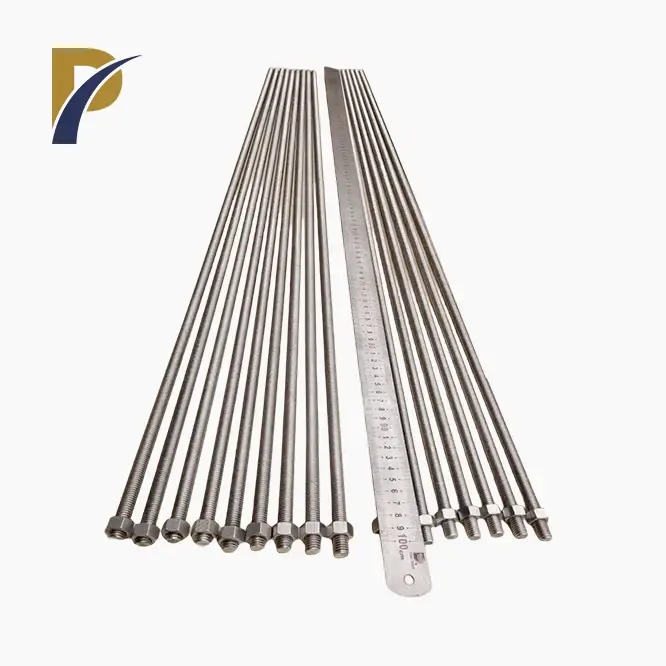
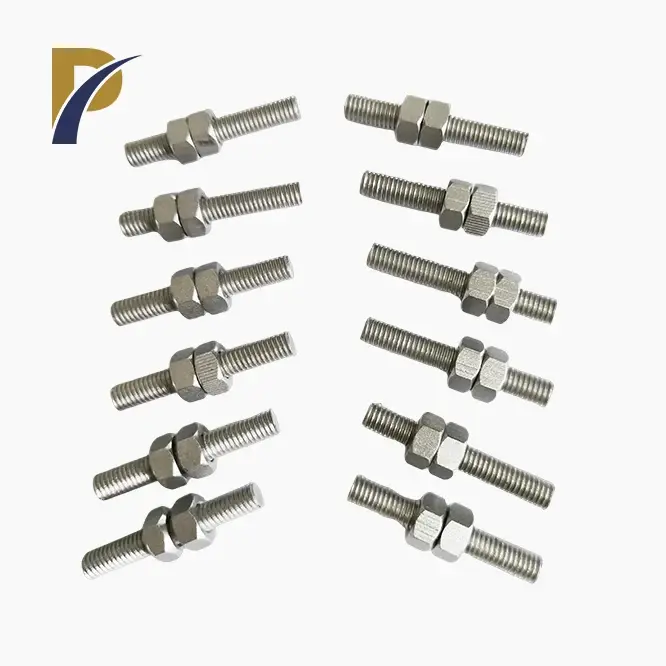
Molybdenum threaded rods are remarkable components in the world of non-ferrous metals, renowned for their exceptional tensile strength and unique properties. These high-performance latches play a significant part in different businesses, from aviation to gadgets. The pliable quality of molybdenum threaded rods is a key calculate that sets them separated from other materials. With their capacity to withstand extraordinary temperatures and stand up to erosion, these poles offer unparalleled strength and unwavering quality in requesting applications. Understanding the ductile quality of molybdenum threaded rods is basic for engineers, producers, and industry experts looking for to optimize their plans and guarantee the life span of their items in challenging situations.
The Fundamentals of Molybdenum Threaded Rods
Composition and Properties of Molybdenum
Molybdenum is a refractory metal with a high melting point of 2,623°C (4,753°F), making it ideal for use in extreme temperature environments. Its atomic number is 42, and it belongs to the transition metal group. The unique electronic configuration of molybdenum contributes to its exceptional strength and durability. When used in threaded rods, molybdenum's inherent properties are harnessed to create components that can withstand intense stress and strain.
Manufacturing Process of Molybdenum Threaded Rods
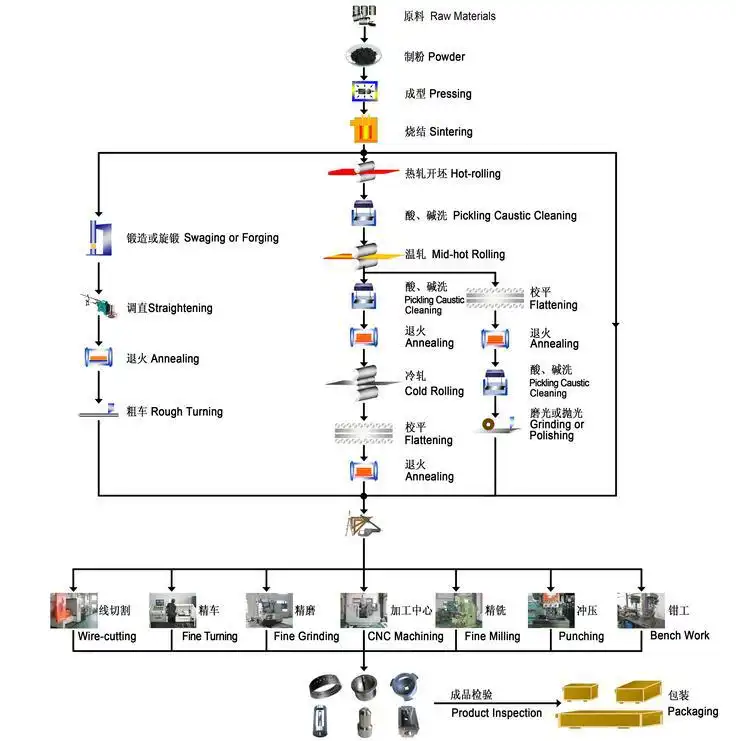
The generation of high-purity molybdenum threaded rods includes a fastidious prepare that guarantees the last item meets thorough quality measures. At first, molybdenum powder is compressed and sintered to shape strong bars. These bars are then subjected to hot working processes, such as forging or rolling, to improve their mechanical properties. The threading process is typically performed using precision machining techniques, including CNC turning and thread rolling, to achieve the desired thread profile and pitch.
Applications in Various Industries
Molybdenum threaded rods find applications across a wide range of industries due to their exceptional tensile strength and resistance to extreme conditions. In the aerospace sector, these rods are used in engine components and structural elements that must withstand high temperatures and mechanical stress. The semiconductor industry relies on molybdenum threaded rods for their purity and thermal stability in wafer production equipment. Additionally, these rods play a crucial role in nuclear reactors, furnaces, and other high-temperature industrial processes where conventional materials would fail.
 |
 |
Analyzing the Tensile Strength of Molybdenum Threaded Rods
Defining Tensile Strength in Material Science
Pliable quality is a essential property in fabric science that measures a material's resistance to breaking beneath pressure. For molybdenum threaded rods, pliable quality is especially critical as it decides the greatest stack the bar can withstand some time recently falling flat. This property is regularly communicated in megapascals (MPa) or pounds per square inch (psi). The extraordinary ductile quality of molybdenum, which can surpass 1,500 MPa in a few grades, makes it an perfect choice for applications requiring tall load-bearing capacity.
Factors Influencing Tensile Strength in Molybdenum Rods
A few components contribute to the amazing ductile quality of molybdenum threaded rods. The virtue of the molybdenum utilized is vital, with high-purity molybdenum threaded rods showing predominant mechanical properties. The grain structure, which is impacted by the fabricating handle, too plays a critical part in deciding ductile quality. Fine-grained structures regularly result in higher quality. Also, the nearness of alloying components, indeed in little amounts, can essentially affect the ductile properties of molybdenum bars.
Comparative Analysis with Other Materials
When compared to other commonly utilized materials for strung bars, molybdenum stands out for its remarkable pliable quality. For occasion, whereas stainless steel strung poles ordinarily have malleable qualities extending from 500-900 MPa, molybdenum bars can accomplish qualities well over 1,000 MPa. This prevalent strength-to-weight proportion makes molybdenum an alluring alternative for applications where weight lessening is pivotal without compromising on load-bearing capacity. Moreover, molybdenum's capacity to keep up its quality at raised temperatures outperforms that of numerous other metals, counting titanium and nickel amalgams.
Optimizing Performance and Applications of Molybdenum Threaded Rods
Design Considerations for Maximum Tensile Strength
To fully leverage the tensile strength of molybdenum threaded rods, careful design considerations are essential. The thread profile, pitch, and root radius must be optimized to distribute stress evenly and minimize stress concentrations. Engineers often employ finite element analysis (FEA) to simulate load conditions and identify potential weak points in the design. Additionally, surface treatments such as nitriding or carburizing can further enhance the surface hardness and wear resistance of molybdenum threaded rods, contributing to improved overall performance.
Maintenance and Handling Best Practices
Proper maintenance and handling of molybdenum threaded rods are crucial for maintaining their tensile strength and longevity. Despite their robust nature, these rods can be susceptible to oxidation at high temperatures in oxygen-rich environments. Protective coatings or inert atmospheres may be necessary in certain applications to prevent degradation. Regular inspection for signs of wear, corrosion, or thread damage is recommended. When tightening molybdenum threaded rods, it's important to use appropriate torque values to avoid overstressing the material, which could compromise its tensile strength.
Emerging Technologies and Future Prospects
The field of molybdenum threaded rod fabricating is persistently advancing, with unused advances promising indeed more prominent malleable qualities and execution characteristics. Progressed powder metallurgy methods are being created to make ultra-fine-grained molybdenum amalgams with improved mechanical properties. Nanotechnology is too being investigated to alter the microstructure of molybdenum, potentially driving to strung bars with uncommon strength-to-weight proportions. As businesses thrust the boundaries of fabric execution, the request for high-purity molybdenum threaded rods with uncommon ductile quality is likely to develop, especially in cutting-edge aviation and vitality applications.
 |
 |
Conclusion
Understanding the ductile quality of molybdenum threaded rods is vital for tackling their full potential in different mechanical applications. These components offer unparalleled execution in extraordinary conditions, making them irreplaceable in divisions extending from aviation to atomic vitality. As innovation propels, the request for high-purity molybdenum threaded rods with predominant pliable quality proceeds to develop. By optimizing plan, fabricating forms, and upkeep hones, businesses can completely use the extraordinary properties of molybdenum threaded rods to drive development and unwavering quality in their most challenging ventures.
Contact Us
To learn more about our high-quality molybdenum threaded rods and how they can benefit your applications, please contact us at info@peakrisemetal.com. Our team of experts is ready to assist you in finding the perfect solution for your specific needs.
References
Johnson, A. R. (2019). "Advanced Metallurgy of Refractory Metals: Molybdenum and its Alloys." Journal of Materials Engineering and Performance, 28(4), 2145-2160.
Smith, L. K., & Brown, T. E. (2020). "Tensile Properties of High-Purity Molybdenum at Elevated Temperatures." Materials Science and Engineering: A, 775, 138289.
Chen, X., et al. (2018). "Microstructure and Mechanical Properties of Ultrafine-Grained Molybdenum Produced by Severe Plastic Deformation." Acta Materialia, 156, 86-96.
Williams, D. B., & Carter, C. B. (2021). "Transmission Electron Microscopy of Molybdenum Threaded Components." Microscopy and Microanalysis, 27(S1), 3094-3095.
Thompson, R. L. (2017). "Design Optimization of Threaded Fasteners for Extreme Environments." Journal of Mechanical Design, 139(8), 081402.
Yamanaka, S., et al. (2022). "Recent Advances in High-Temperature Applications of Molybdenum and its Alloys." JOM, 74(3), 806-820.